

 L'institut de MontpellierNotre vision est celle d’un bassin méditerranéen au sein duquel l’esprit de coopération prévaut.
 Publications du CIHEAMNos publications et outils de communication visent à faciliter les processus de prise de décision pour les acteurs politiques, économiques et agricoles de la région méditerranéenne.
 Actualités et événements
 Revue de presse (Scoop.it)
 Programmes de MasterLe CIHEAM Montpellier c’est à la fois un accompagnement personnalisé et une ouverture à l’international.
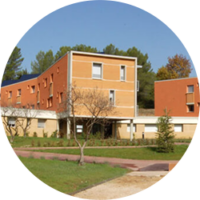 Campus & vie étudianteDepuis 1962 nous accueillons près de 95% d’étudiants internationaux.
 Portail documentaireUn Centre de documentation unique sur la Méditerranée,
investi dans le partage des connaissances.
Portail documentaireUn Centre de documentation unique sur la Méditerranée,
investi dans le partage des connaissances. Production scientifiqueLa politique des publications du CIHEAM est depuis longtemps engagée dans le mouvement du libre accès et du partage des connaissances.
 Devenir partenairesTisser des partenariats fait partie de l’ADN du CIHEAM Montpellier... Rejoignez ses projets ou ses formations, soutenez ses actions.
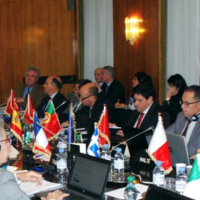 Réunions ministériellesA travers les Ministérielles , le CIHEAM contribue à la construction d'un dialogue entre les pays méditerranéens autour des questions relatives à l'agriculture et au monde rural.
Growing Climate Resilience in Remote rural Areas through Community Empowerment
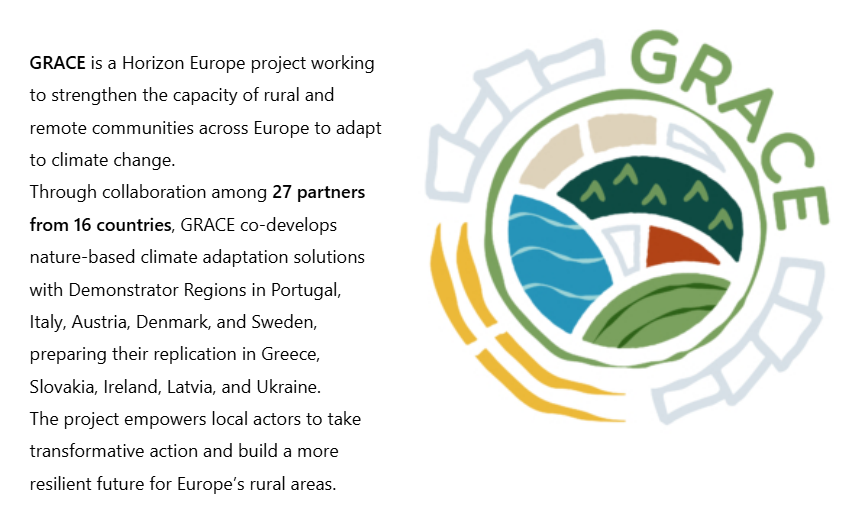
| Objectives: GRACE project focuses on addressing the needs of rural and small and medium communities localised in EU Remote Rural Areas (RRAs) to adapt and build resilience against Climate Change, by strengthening their capacities and empowering them to become actors of change and take transformative action. A consortium of 27 organizations from 16 countries implements the project, with 5 Demonstrator Regions (DRs) in Austria, Denmark, Italy, Portugal and Sweden co-developing innovative solutions centered on naturebased approaches. These solutions are designed to deliver multifunctional, place-based social, environmental and economic benefits. In addition, circular economy principles will be embedded within these solutions to promote sustainable resource use, regenerative practices, and closed-loop systems, further enhancing local adaptation capacity. At the same time, the project will enhance local socio-economic activities, promote circular business models, maximize the value of natural capital, and help mitigate the challenges of depopulation and aging in RRAs. 5 Replicator Regions (RRs) in Greece, Ireland, Latvia, Slovakia and Ukraine will prepare for adopting the innovations developed by the DRs. Finally, GRACE will also engage Observer Regions (ORs) to follow and potentially replicate these solutions, fostering widespread CC adaptation across Europe’s rural areas. By integrating Nature-based Solutions (NBS), digital technologies, and inclusive community participation, GRACE will catalyze transformative adaptation in EU rural territories, ensuring that RRAs can successfully navigate climate challenges ahead and secure a sustainable, climate- resilient future. |
Results expected
GRACE will elevate the ambition in demonstrating solutions tailored to European rural areas and small to medium sized local communities through the application of an interdisciplinary approach. It will go beyond the State of the Art across several interconnected key dimensions, including:
• Transformative CA: GRACE will strategically focus on the typology of rural areas that need the most support in CA to consider: i) how rural and small and medium-sized communities in the most remote areas of the EU can be empowered to become active actors of change, induce transformation and innovation in the enabling conditions, and protect the KCS from present and future climate risks ii) what solutions and adaptation pathways can be followed iii) and explore, if and how, the journey to achieve transformative climate resilient communities can represent an opportunity for the development of RRA communities and to reduce the urban-rural discontinuity.
• Advanced multi-hazard risk modelling and scenario analysis: GRACE will fill a current gap concerning the lack of availability of climate risk assessments in RRA. The gap significantly reduces the institutional capacity of public authorities to adapt to CC with integrated planning and the design of holistic measures able to account for multi-hazards risk scenarios. Using new data mapping and data generation techniques (WP1) GRACE will develop detailed climate risk analysis to accurately reflect and unravel the complex interactions between different hazards and their impacts across various rural landscapes, including scenario planning – Social innovation and community empowerment.
MORE INFORMATIONS:
Contacts
Coordination
- BERCHOUX Tristan, CIHEAM-IAMM Project Manager, berchoux@iamm.fr
- AVIGNON Virginie, CIHEAM-IAMM Project Assistant, avignon@iamm.fr
Partners
- CMCC - Centro Euro-Mediterraneo sui Cambiamenti Climatici (Coordinator)
- INOVA+ – INNOVATION SERVICES, SA
- CIHEAM-IAMM (WP Leader)
- STICHTING VU
- EUROPEAN PUBLIC LAW ORGANIZATION
- ASSOCIATION EUROPEENNE POUR L’INNOVATION DANS LE DEVELOPPEMENT LOCAL (WP Leader)
- STOWARZYSZENIE CENTRUM ROZWIAZAN SYSTEMOWYCH
- EUROPEAN SCIENCE COMMUNICATION INSTITUTE (ESCI) GGMBH (WP Leader)
- BAB BUNDESANSTALT FUR AGRARWIRTSCHAFT UND BERGBAUERNFRAGEN (WP Leader)
- ACONIUM GMBH
- IfLS INSTITUT FUER LAENDLICHE STRUKTURFORSCHUNG EV (WP Leader)
- EUROPEAN RURAL DEVELOPMENT NETWORK
- Comunidade Intermunicipal do Baixo Alentejo
- Gemeinsame Region Bucklige Welt – Wechselland
- Comune di Cavallino Treporti
- PERIFEREIA THESSALIAS
- VIDZEMES PLANOSANAS REGIONS
- SVERIGES LANTBRUKSUNIVERSITET
- REGION VASTERBOTTEN
- AALBORG KOMMUNE
- DANMARKS TEKNISKE UNIVERSITET
- Zilina self-governing region
- Zalishchyky city council
- ASSOCIACAO ESTACAO BIOLOGICA DE MERTOLA
- INSTITUTO POLITECNICO DE BEJA
- MAYO COUNTY COUNCIL
Source of funding

Funded by the European Union under the Horizon Europe programme
Follow GRACE!
- Website: https://www.grace-project.eu/
- on LinkedIn -> GRACE