

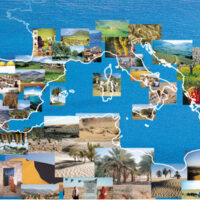
 CIHEAM MontpellierOur vision is that of a Mediterranean basin characterised by a spirit of cooperation.
 CIHEAM publicationsOur publications and communication tools aim to facilitate decision-making processes for political, economic and agricultural actors in the Mediterranean region
 News and events
 Press review (Scoop.it)
 Master programmesThe CIHEAM Montpellier stands for both personalised accompaniment and international openness.
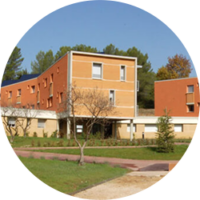 Campus & student lifeSince 1962, almost 95% of our foreign students have been granted accommodation on site.
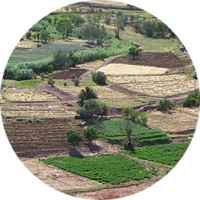 Doctoral platformShaping the scientists of tomorrow through research training… A natural commitment of the CIHEAM Montpellier
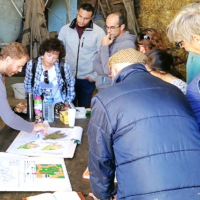 ProjectsOur research and cooperation projects are tools for inclusive development, they take into account the populations and rural and coastal territories of the Mediterranean.
 Mediterranean online catalogueA unique Documentation Center on the Mediterranean,
invested in sharing knowledge.
Mediterranean online catalogueA unique Documentation Center on the Mediterranean,
invested in sharing knowledge. Scientific productionThe scientific production of the CIHEAM Montpellier is the fruit of collaborations by our lecturer-researchers, associated experts, students and research partners.
 Becoming partnersCreating partnerships is part of the genetic make-up of the CIHEAM Montpellier... Join one of its projects or study programmes, support its actions.
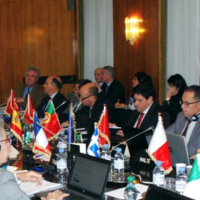 Ministerial meetingsThrough the Ministerial, CIHEAM contributes to the construction of a dialogue between the Mediterranean countries around questions relating to agriculture and the rural world.
Our constant concern is to measure your satisfaction and our results, and to adjust our practices in order to improve continuously. This is reflected in our ISO 9001 certification since 2008.
An integrated approach
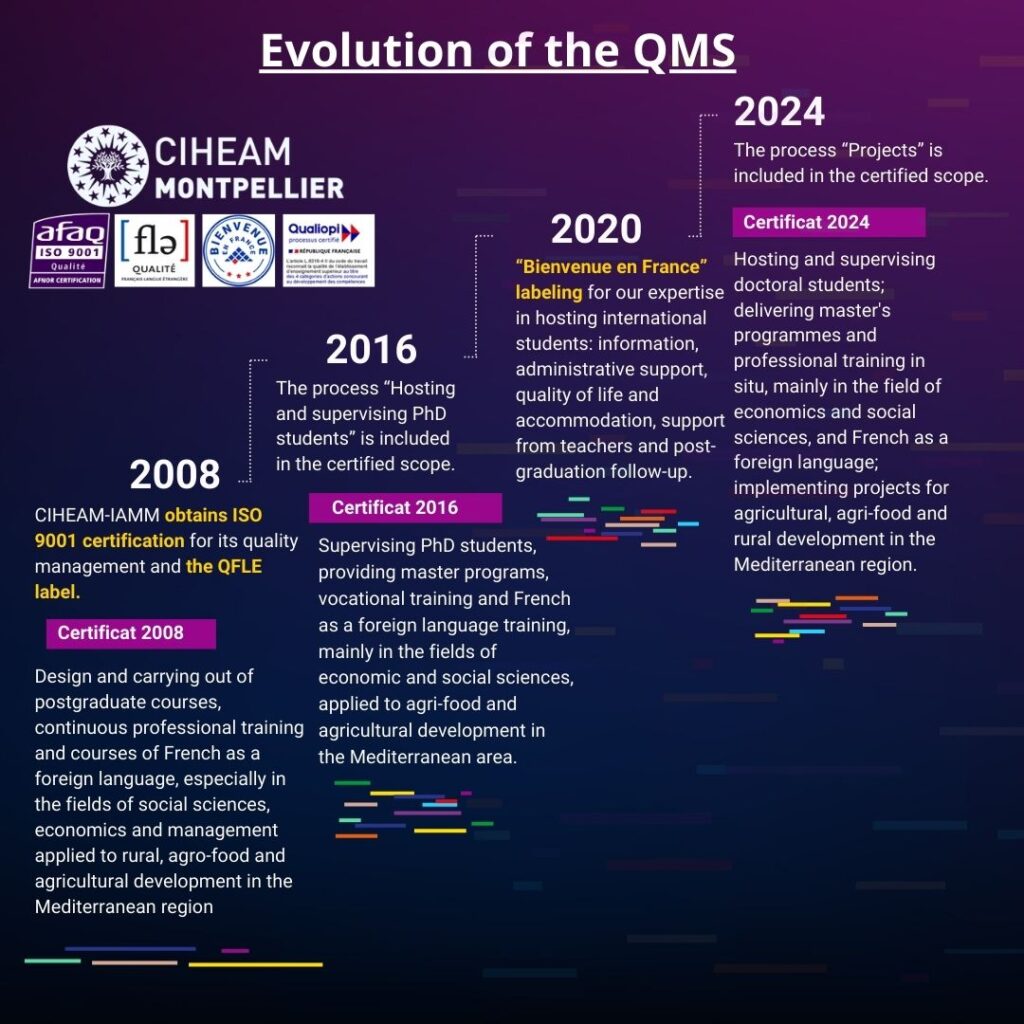
Since 2008, CIHEAM Montpellier has validated its continuous improvement process by obtaining ISO 9001 certification for its management of on-site training. Following the integration of the Project process, from 2024 onwards, the CIHEAM-IAMM management system is certified for the following activities:
Hosting and supervising doctoral students; delivering master's programmes and professional training in situ, mainly in the field of economics and social sciences, and French as a foreign language; implementing projects for agricultural, agri-food and rural development in the Mediterranean region.
Activities within the Quality scope
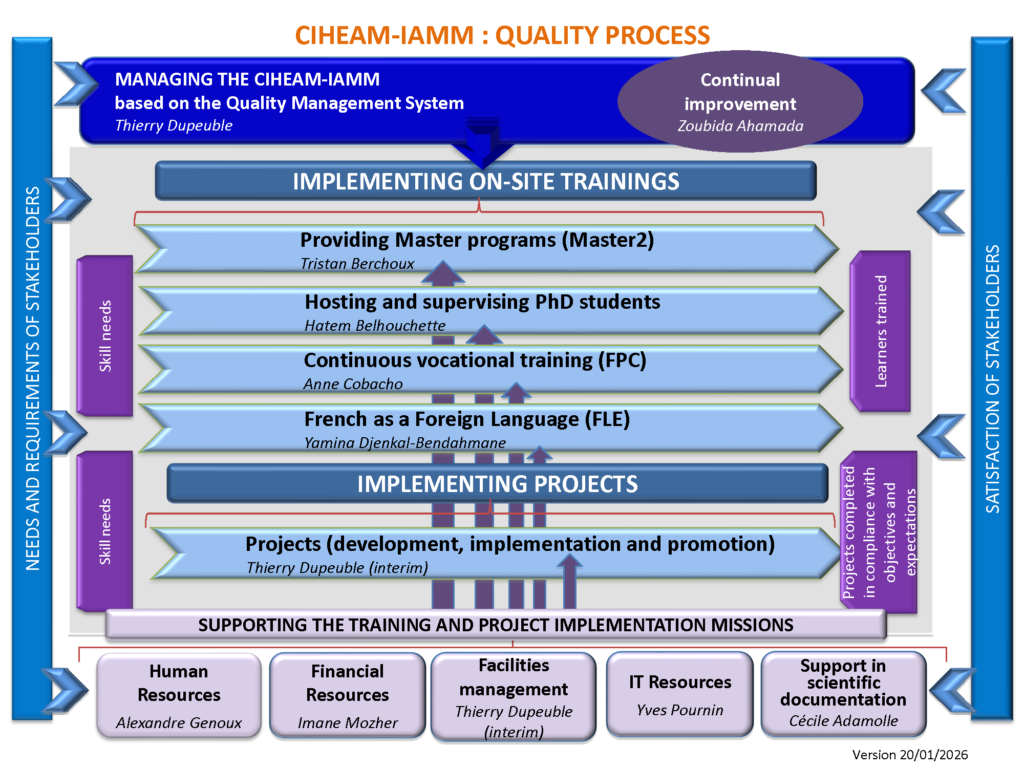
The quality management system (QMS) includes eleven activities working in synergy.
The management’s objectives: a framework for our actions
Our priority objectives for training, research, and development cooperation are part of the strategic directions that structure the current formulation of the Institutional Project (2023-2026). In 2026, our efforts will be focused primarily on:
OS1: Strengthening the training offerings by asserting the international dimension in recruitment and implementation, and by consolidating local anchoring
-
Strengthen the double-degree framework in new countries through Erasmus+ funding.
-
Finalise, based on the evaluation conducted by HCERES, the new academic program offering, ensuring consistency with that of our local and international partners.
OS2: Enhancing visibility and clarity regarding the specific expertise mobilised and developed in research projects, technical assistance for development, and training programs
-
Build on the successes of 2025 (Euro-Africa Biennale, Parmenides) and the IFSA 2026 Conference.
-
Sustain the visibility gained following the CGAAER mission with the Ministry for Europe and Foreign Affairs (MEAE).
-
Continue our active involvement in national consultation bodies coordinated by the Ministry of Higher Education and Research (MESRI).
OS3: Developing site-based projects that contribute to research and training
-
Formalise partnerships for the maintenance and enhancement of the site, with an extension to the promotion of workspaces (developing a “seminar” offering).
-
Further develop prospects for a partnership with the Metropolitan Authority on biodiversity (Park).
OS4: Be exemplary in our environmental and social practices and provide ourselves with the means to be eco-responsible daily
-
Strengthen the operation of the Listening and Support Mechanism.
-
Continue the self-assessment process to obtain the DD&RS label (Sustainable Development and Social Responsibility label).
OS5: Develop the Institute's internal organisation to better ensure the efficient mobilisation of resources and skills, and guarantee the sustainability of the business model
-
Finalise the reorganisation of the Accounting and Logistics & Estates Departments initiated in 2025.
-
Strengthen the internal organisation supporting project development and management, and implement a digital time-tracking tool.
OS6: Maintaining the Institute’s commitment to joint CIHEAM initiatives
- Remain involved in the working groups and joint actions carried out with CIHEAM and its other Mediterranean agronomic institutes (Bari, Zaragoza, Chania).
Sustainable development framework
Awareness of the stakes of sustainable development has been growing for decades. Climate disruption, environmental damage, the depletion of certain resources, particularly energy, and growing inequalities are forcing us to act, each at our own level. Committing to sustainable development means implementing a realistic and concrete progress approach: improving internal cohesion, advancing ideas, raising awareness, empowering and informing staff and students, structuring purchases, reducing consumption of non-renewable resources …
In its missions as an international platform for training, knowledge production, scientific exchange and cooperation for the Mediterranean and hosting students on its campus, the Mediterranean Agronomic Institute of Montpellier (CIHEAM-IAMM) is committed to contributing to the Sustainable Development Goals (SDGs) adopted in September 2015 by the UN as part of the Agenda 2030. The Institute is committed to communicate on the framework's commitments, formalize them where necessary, monitor and make them progress through the Quality approach it has adopted.