
 CIHEAM MontpellierOur vision is that of a Mediterranean basin characterised by a spirit of cooperation.
 CIHEAM publicationsOur publications and communication tools aim to facilitate decision-making processes for political, economic and agricultural actors in the Mediterranean region
 News and events
 Press review (Scoop.it)
 Master programmesThe CIHEAM Montpellier stands for both personalised accompaniment and international openness.
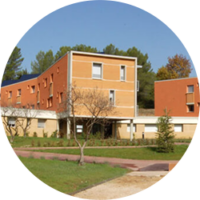 Campus & student lifeSince 1962, almost 95% of our foreign students have been granted accommodation on site.
 Doctoral platformShaping the scientists of tomorrow through research training… A natural commitment of the CIHEAM Montpellier
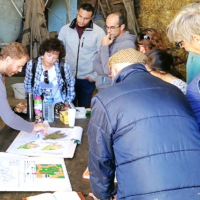 ProjectsOur research and cooperation projects are tools for inclusive development, they take into account the populations and rural and coastal territories of the Mediterranean.
 Mediterranean online catalogueA unique Documentation Center on the Mediterranean,
invested in sharing knowledge.
Mediterranean online catalogueA unique Documentation Center on the Mediterranean,
invested in sharing knowledge. Scientific productionThe scientific production of the CIHEAM Montpellier is the fruit of collaborations by our lecturer-researchers, associated experts, students and research partners.
 Becoming partnersCreating partnerships is part of the genetic make-up of the CIHEAM Montpellier... Join one of its projects or study programmes, support its actions.
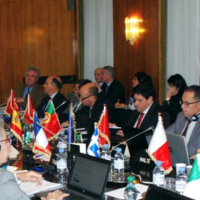 Ministerial meetingsThrough the Ministerial, CIHEAM contributes to the construction of a dialogue between the Mediterranean countries around questions relating to agriculture and the rural world.
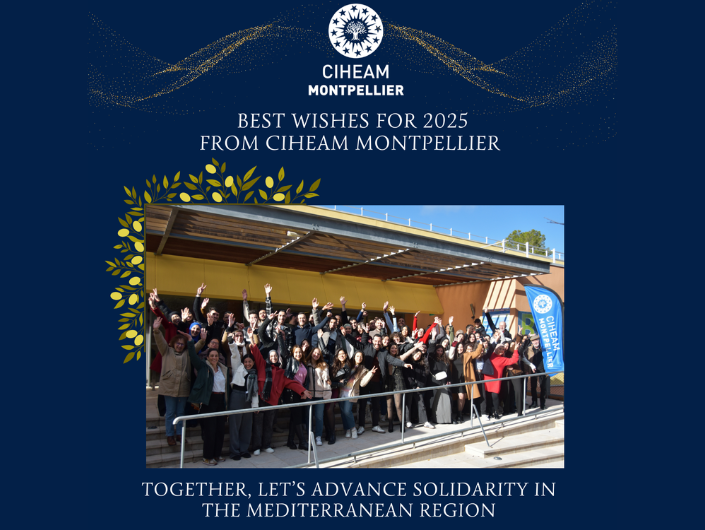
Best wishes for 2025 from CIHEAM Montpellier
Description.
Posted on December 11th, 2023
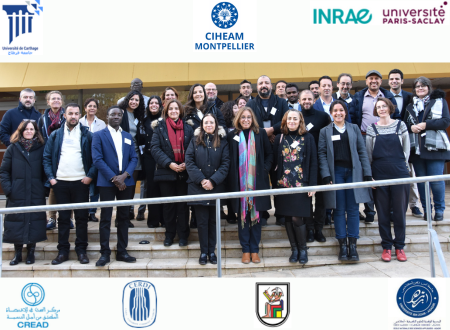
By CIHEAM-IAMM (France), INRAE -Université Paris-Saclay (France), and Université de Carthage – L.R . Modélisation et Analyse Statistique et Economique-ESSAI (Tunisia),
In partnership with CERDI – Université de Clermont-Auvergne (France), CREAD (Algeria), and with the support of the Francophone Economics and Political Science Department of Cairo University (Egypt) and ENSA, Université Ibn Zohr (Morocco).
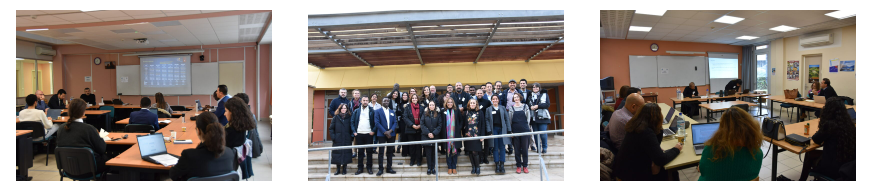
This Mediterranean day is devoted to the presentation of work in mathematical, statistical and econometric modelling of economic phenomena.
It is dedicated to the work of researchers from around the Mediterranean or working on themes of interest to this region, with a particular focus on the work of young researchers (doctoral students, post-doctoral students) from both sides of the Mediterranean. Participants will come from France, Algeria, Morocco, Tunisia, Greece and Egypt.
This meeting aims, on the one hand, to promote the work of young researchers in this region by giving them the benefit of the experience of more experienced researchers. It is also an opportunity to meet and exchange ideas, to consider partnerships for international projects and to build a lasting network of young Mediterranean researchers.
Reposted on December 7, 2023
the deadline for proposal submission of the NPP-SOL project’s call for a service provider in communication and dissemination has been extended to the 15th December 2023.
Term of reference for a service provider in support for communication and dissemination
Context
NPP-SOL (Modelling and technological tools to prevent surface and ground water bodies from agricultural non-profit source pollution under Mediterranean conditions) is an awarded project under the PRIMA Programme “Partnership for Research and Innovation in the Mediterranean Area”, Section 2 (Projects funded by Participant States), – Multi-topic 2022 – Topic 2.1.1 RIA (Prevent and reduce land
and water salinization and pollution due to agri-food activities).
The general objective of NPP-SOL is to prevent diffuse pollution of water resources due to NPS
agricultural pollutants under the Mediterranean soil and environmental conditions, according to the
objectives of the new Green Deal and Farm-to-Fork strategies. NPP-SOL will integrate site-specific
best management practices for improving soil, water, fertilizers and crop management with sitetailored and affordable-costs technologies for preventing natural bodies pollution. Common to all the
adopted methodologies-technologies will be their sustainability and economic efficiency, and their
adherence to circular economy approaches.
CIHEAM Montpellier participates in this project as a partner and is the leader and the co-leader for
different work packages (WP) within the project.
Description of the work package and tasks
Under NPP-SOL’s Work Package 5 for which CIHEAM Montpellier is the leader, different tasks will be
undertaken in the objective of:
− Communication and dissemination of the project’s activities and results, with the final objective
of amplifying and raising awareness about NPP-SOL added value in economic, technical,
environmental and social terms.
− Dissemination of the results to stakeholders beyond those directly engaged in the project.
To assure the quality of these tasks’ implementation, a sub-contracting third party (hereinafter service
provider) is needed to support CIHEAM Montpellier team.
Submission deadline and selection procedure
The deadline for the quotation and proposal submission is the the 15th December 2023 at 12 pm (Paris
time).
Proposals should be submitted in English by email with the subject “NPP-SOL service provider
proposal” addressed to:
Hatem BELHOUCHETTE, NPP-SOL Scientific Member: belhouchette@iamm.fr
Georgios KLEFTODIMOS, NPP-SOL Scientific Member: kleftodimos@iamm.fr
Nhien NGUYEN: nguyen@iamm.fr
Aybike Bayraktar: aybayraktar@iamm.fr
Posted on December 6, 2023
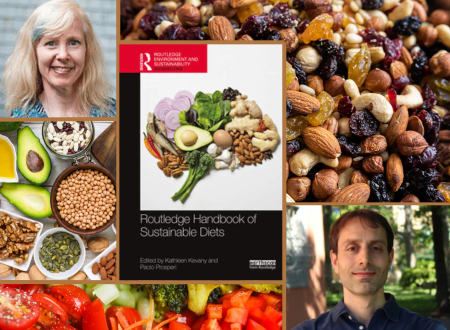
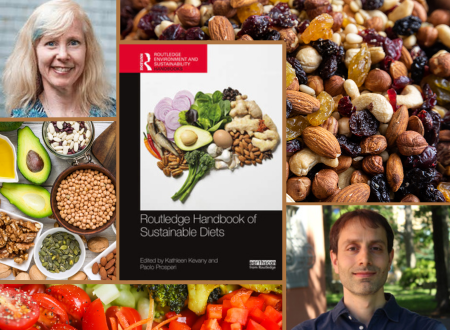
Who: Dalhousie researchers collaborate with international colleagues on global launch of Routledge Handbook of Sustainable Diets.
What: This handbook is a must-read, comprehensive, and state of the art overview of sustainable diets, an issue critical to the environment and the health and well-being of society. Sustainable diets seek to minimise and mitigate the significant negative impact food production has on the environment and to usher in delicious alternatives that support optimal human, animal, and planetary.
When: Friday, December 8th 12:30 p.m.-2:15 p.m. Atlantic time zone.
Where: In-person- Dalhousie Faculty of Agriculture, President’s Board Room, First Floor, Cumming Hall, 62 Cumming Dr, Truro, NS. Canada B2N 4H5
Online concurrently in a Zoom Meeting Meeting ID: 874 9745 8101; Passcode: 35414
Why: This handbook is of the greatest importance with timely, critical, and actionable contents. We encourage all researchers and institutions to a secure a copy for their collection. This definitive guide on sustainable diets delivers 55 insightful chapters with solutions by 130+ of the world’s leading experts. Experts: Handbook Sections and Chapter Titles of Presenting Authors FRAMING and VISION 2. Dignity, justice, and the right to food Francis Adams 3. Reframing the sustainable diets narrative: Shifting diets by confronting systemic racism in the U.S. food systems Gabriel R. Valle
For more information contact:
Dr. Paolo Prosperi: prosperi@iamm.fr
Dr. Kathleen Kevany: kkevany@dal.ca
🔎 Sustainable diets promotions
🔎 Press Release sustainable diets
Posted on December 1st, 2023
Term of reference for a service provider in support for the work package 1‘s implementation
Context
NPP-SOL (Modelling and technological tools to prevent surface and ground water bodies from agricultural non-profit source pollution under Mediterranean conditions) is an awarded project under the PRIMA Programme “Partnership for Research and Innovation in the Mediterranean Area”, Section 2 (Projects funded by Participant States), – Multi-topic 2022 – Topic 2.1.1 RIA (Prevent and reduce land
and water salinization and pollution due to agri-food activities).
The general objective of NPP-SOL is to prevent diffuse pollution of water resources due to NPS
agricultural pollutants under the Mediterranean soil and environmental conditions, according to the
objectives of the new Green Deal and Farm-to-Fork strategies. NPP-SOL will integrate site-specific
best management practices for improving soil, water, fertilizers and crop management with sitetailored and affordable-costs technologies for preventing natural bodies pollution. Common to all the
adopted methodologies-technologies will be their sustainability and economic efficiency, and their
adherence to circular economy approaches.
CIHEAM Montpellier participates in this project as a partner and is the leader and the co-leader for
different work packages (WP) within the project.
Description of the work package and tasks
Under NPP-SOL’s Work Package 1 for which CIHEAM-IAMM is the leader, different tasks will be undertaken in the objective of:
− Settling of the project Stakeholders-Researchers Hub and of the four living hubs of the four case studies (Italy, Spain, Morocco and Israel)
− Defining the stakeholders’ entities driven advices and guidelines to develop of Modelling Tool (MT) in the WP4.
− Identifying Scaling Up and Scaling Out opportunities of the site-specific best management practices and pollution-preventing technologies.
To assure the quality of these tasks’ implementation, a sub-contracting third party (herein after service provider) is needed to support CIHEAM-IAMM team.
Submission deadline and selection procedure
The deadline for the quotation and proposal submission is the 18th December 2023 at 12 pm (Paris
time)
Proposals should be submitted in English by email with the subject “NPP-SOL WP1 service
provider proposal” addressed to:
Hatem BELHOUCHETTE, NPP-SOL Scientific Member: belhouchette@iamm.fr
Georgios KLEFTODIMOS, NPP-SOL Scientific Member: kleftodimos@iamm.fr
Aybike Bayraktar: aybayraktar@iamm.fr
Posted on November 24, 2023
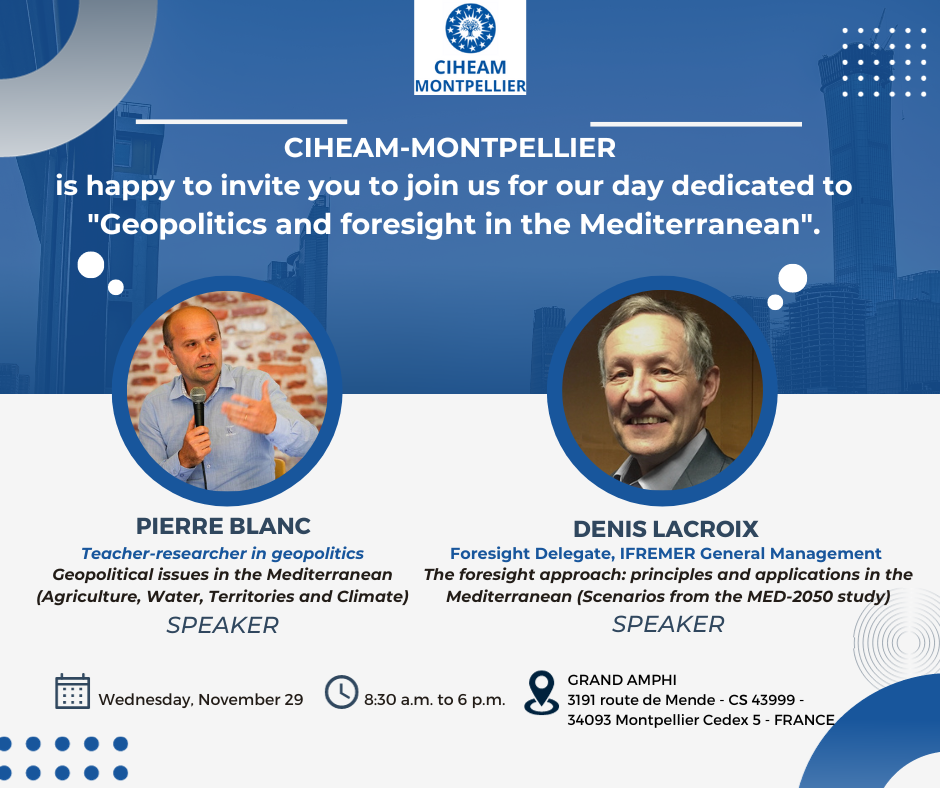
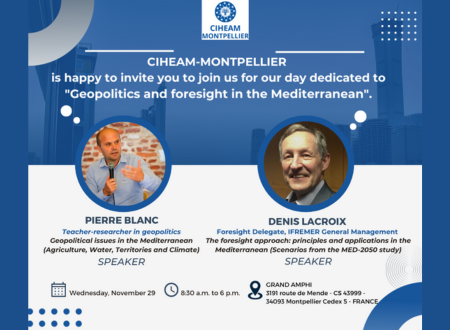
CIHEAM-Montpellier is happy to announce its upcoming ” Geopolitics and Foresight in the Mediterranean ” Day, a not-to-be-missed event taking place on November 29.
This day will be a great opportunity to explore the geopolitical dynamics and prospective projections of the Mediterranean region, led by renowned experts.
Program:
8:30am – 12:30pm: Join us for a captivating talk by Mr. Pierre Blanc, geopolitics expert at Bordeaux Sciences Agro and Sciences Po Bordeaux. Editor-in-chief of the renowned magazine “Confluences Méditerranée” and author of several books dedicated to the Mediterranean, his latest book “Géopolitique et Climat”, published in 2023, will be at the heart of his presentation. Mr. Blanc will explore with depth and expertise the geopolitical issues linked to agriculture, water, territories, and climate in the Mediterranean region.
2pm to 3:30pm: We’ll have the honor of welcoming Mr.Denis Lacroix, Delegate for Foresight at the French Institute for Research on the Sea (IFREMER) and Vice-President of Plan Bleu. He brilliantly coordinated the elaboration of the MED-2050 scenarios. His presentation will focus on essential prospective perspectives for the future of the Mediterranean.
This captivating, knowledge-rich day will be streamed online for maximum accessibility to an engaged audience. To take part in this enriching event, please register here.
We look forward to welcoming you to this exceptional day of knowledge-sharing and essential exchanges!