GRANULAR

Giving Rural Actors Novel data and re-Useable tools to Lead public Action in Rural areas

Departing from an updated conceptualisation of rurality based on the multi-dimensional nature of contemporary rural-urban interrelations and interdependencies, GRANULAR will generate new insights for characterising rural diversity.

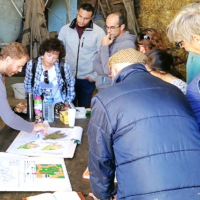
Led by CIHEAM Montpellier, GRANULAR gathers 23 partners (academic institutes, international organisations, NGOs, rural networks and local authorities) and will use participatory methods in 16 pilot territories across Europe in order to capture the complexity of challenges faced by rural areas with a local stakeholders’ perspective.

The project is structured in 7 work packages with many inter-linkages and will contribute to current scientific discussions through:

  • (i) advancement of concepts to characterise rural diversity and grasp rural proofing;
  • (ii) novel methods to generate data relevant to rural areas, and new thematic datasets;
  • (iii) empirical findings from Multi-Actor Labs and from data analyses for specific topics.

All partners will contribute to the design of data, indicators and tools. Co-construction will ensure that GRANULAR takes stock of local realities and needs, while fitting the findings in overarching policy frameworks. Data and tools emerging from the project will be developed through an open strategy that will ensure replicability and will be made available online through public repositories and a dedicated online platform. In addition, GRANULAR will create a Rural Compass, that takes into account the factors affecting rural communities and their functional characteristics, informing policymakers and rural actors for the design of tailored rural policies for a just, resilient and inclusive development.

Website : https://www.ruralgranular.eu/ 

GRANULAR 2023 results

More information

Source of funding

  • European Union, Horizon Europe programme
  • UKRI United Kingdom funds on research and innovation

Programme and contact references

Partners

  • CIHEAM Montpellier
  • NORDREGIO
  • WAGENINGEN UNIVERSITY
  • INTERNATIONALES INSTITUT FUER ANGEWANDTE SYSTEMANALYSE
  • UNIVERSITA DI PISA
  • GEOPONIKO PANEPISTIMION ATHINON
  • ASSOCIATION EUROPEENNE POUR L’INFORMATION SUR LE DEVELOPPEMENT LOCAL
  • CESKA ZEMEDELSKA UNIVERZITA V PRAZE
  • CENTRE NATIONAL DE LA RECHERCHE SCIENTIFIQUE CNRS
  • UNIVERSITE PARIS CITE
  • EUROPEAN RURAL DEVELOPMENT NETWORK
  • JOHANN HEINRICH VON THUENEN-INSTITUT, BUNDESFORSCHUNGSINSTITUT FUER LAENDLICHE RAEUME, WALD UND FISCHEREI
  • ECORYS
  • UNIVERSIDAD DE VIGO
  • PARTENARIAT POUR L’EUROPE RURALE
  • REGION VASTERBOTTEN
  • GEMEENTE OPSTERLAND (P10)
  • ASSOCIAZIONE DISTRETTO RURALE DELLAVAL DI CECINA
  • LUONNONVARAKESKUS
  • Pays Pyrénées-Méditerranée
  • POLITECHNIKA KOSZALINSKA
  • CIHEAM Chania
  • UNIVERSITA DEGLI STUDI DI MILANO
  • UNIVERSITY OF SOUTHAMPTON
  • THE JAMES HUTTON INSTITUTE

Med-Amin Network

Mediterranean Agricultural Markets Information Network

The MED-Amin network was created in 2014 at the request of the Ministers of Agriculture of the 13 CIHEAM member countries, against the background of the world food crises in 2008-2009, then 2011.

MED-Amin is a network for monitoring agricultural markets and food systems that contributes to Pillar 4 “Crises and resilience” of CAPMED 2025. It focuses in particular on five cereals (soft wheat and durum wheat, barley, maize and rice) which are essential to the food security in the Mediterranean.

MED-Amin aims to limit the excessive volatility of food prices by encouraging the transparency of international markets for basic agricultural products.

The network thus encourages the coordination of national market policies.

>> More information on MED-Amin Network

Healthy Food Africa

Improving nutrition in Africa by strengthening the diversity, sustainability, resilience and connectivity of food systems

HealthyFoodAfrica is an EU-funded research & innovation action aiming at sustainable, equitable and resilient food systems in African cities. The project is a collaborative effort by 17 partners in both Europe and Africa.

The overall goal of HealthyFoodAfrica is to make food systems in 10 African cities in six countries across three African macro-regions more sustainable, equitable and resilient by reconnecting food production and food consumption in effective ways.

>> Site web

Objectives

Improving access to nutritious food is a systemic challenge. African agri-food systems are facing numerous challenges related to climate change, rapid population growth and urbanization. Both food production and consumption patterns must change in order to provide access to nutritious food while counteracting social inequality, environmental degradation, food loss and inadequate waste management.

Activities

17 European and African partners work in close collaboration to improve nutrition in Africa by strengthening the diversity, sustainability, resilience and connectivity of food systems.

The work in HealthyFoodAfrica is localized in ten African cities, the so-called Food System Labs (FSL). Cross cutting work is undertaken in nine work packages.

Expected results and impact

  • HealthyFoodAfrica seeks to create 10 Food System Labs (FSLs) in 10 cities and 6 countries in Eastern, Western and Southern Africa. Each FSL will bring together local stakeholders – farmers, entrepreneurs, businesses, and policymakers. With the support of the partners, labs will tackle particular locally relevant food system challenges, from consumer awareness to sustainable production, local food diversity, improved post-harvest technologies and food safety.

  • The Food System Labs aim to link local producers and consumers, diversify the product selection, and bolster local supply chains to create a more sustainable production system and promote more healthy and equitable diets. The Food System Labs are supported by researchers and practitioners from Europe and Africa, who will also enhance and facilitate the learning processes within each lab and across them.

  • The participatory, multi-actor approach will ensure food system transformation not only in the ten Food System Lab cities but also in wider terms: the local solutions developed and piloted in the Food System Labs will be shared and disseminated to allow their adaptation to other countries and circumstances as well.

  • “Only through linking the diverse expertise and knowledge this type of consortium includes, there is potential to develop tools for actual transformation. Both local knowledge and new technology are necessary, but the key to achieving sustainable change is in combining these to respond to context-specific challenges” summarizes HealthyFoodAfrica Project Coordinator, Senior Scientist Mila Sell from the Natural Resources Institute Finland.

More information

Source of funding

European Union, H2020 project

Programme and contact references

  • Coordinator: Natural Resources Institute Finland, healthyfoodafrica(a)luke.fi
  • Principal Investigator at CIHEAM Montpellier: Paolo Prosperi , Lecturer-researcher – prosperi@iamm.fr

Partners

  • The Alliance of Bioversity International and CIAT
  • Council for Scientific & Industrial Research, Ghana (CSIR)
  • African Population & Health Research Centre Kenya (APHRC)
  • Norwegian Institute of Bioeconomy Research (NIBIO)
  • University of Helsinki, Finland (UH)
  • Bahir Dar University, Ethiopia (BDU)
  • University of Makerere, Uganda (MAK)
  • University of Zambia (UNZA)
  • University of Pisa, Italy (UNIPI)
  • University of Abomey-Calavi, Benin (UAC)
  • Aeres University of Applied Sciences, Netherlands
  • Hivos
  • Finn Church Aid (FCA)
  • Centre for Initiatives on Food Security and Environment (GIFSE)
  • Mentes Visiveis Lda (MV)
  • House of Böna Ltd
  • Centre International de Hautes Etudes Agronomiques Méditerranéennes – Institut Agronomique Méditerranéen de Montpellier (CIHEAM Montpellier)

SUPMED

Collective and contextualized strategies to promote resilient and sustainable agricultural production in rural Mediterranean areas

SupMed

Réduire d’une façon structurelle et durable la surexploitation des ressources hydriques et à améliorer le revenu des ménages agricoles au Liban et en Egypte dans un contexte de changement climatique.

Proposer, mettre en œuvre et évaluer des initiatives intégrées, agronomiques et socio-économiques, basées sur l’agroécologie afin de réduire la dépendance à l’eau de chacun des territoires. Ces initiatives seront concertées avec les acteurs et adaptées au contexte des deux territoires ciblés: la Plaine de Beqaa au Liban et le Gouvernorat de Louxor en Egypte.

SupMed vise l’adhésion d’au moins 400 agriculteurs par territoire à une charte volontaire pour la mise en œuvre de stratégies d’adaptation basées sur des pratiques agroécologiques.

Au niveau institutionnel, le projet contribuera à renforcer et mieux structurer, en termes de conseil agricole, le partenariat public-privé au niveau des deux pays.

Il s’agit principalement de capitaliser autour de cette expérience de partenariat et de formuler des recommandations pour les prochaines politiques agricoles. Ce travail de capitalisation sera d’autant plus important que le projet contribuera (au moins partiellement) à l’élaboration des prochaines politiques agricoles nationale (Liban) et régionale (Egypte).

>> Site web

More information

Source of funding

  • Fond Français pour l’Environnement Mondial
  • Plan Vert (Ministère de l’Agriculture), Liban
  • Executive Agency for the Comprehensive Development Projects, ministère de l’agriculture (EACDP), Egypte
  • CIHEAM Montpellier, France
  • Egyptian Association for Sustainable Development de Louxor (EASD), Egypte
  • Centre Agricole privé de Hermel (FSC), Liban

Programme and contact references

Partners

Le CIHEAM Montpellier: Institut Agronomique Méditerranéen de Montpellier, Coordinateur et co-financeur du projet, assure la maîtrise d’ouvrage et la coordination scientifique.

Partners in Lebanon

  • Le Plan Vert et le projet HASAD, cofinanceur et membre du comité de pilotage SupMed
  • Le Centre Agricole Privé de Hermel, Maitrise d’œuvre du projet SupMed sur le terrain
  • L’Union des municipalités de Baalbek-Hermel et l’Union des coopératives de Hermel, Membre du Comité d’appui du projet SupMed
  • Le Ministère de l’Agriculture, Membre du comité d’appui SupMed
  • La Faculté d’agronomie de l’Université libanaise (Département d’Économie Rural), Membre du comité d’appui SupMed

Partners in Egypt

  • Executive Agency for the Comprehensive Development Projects (EACDP), Cofinanceur et membre du comité de pilotage Supmed
  • Egyptian Association for Sustainable Development (EASD), Maitrise d’œuvre du projet SupMed en Egypte
  • Le Centre d’études de développement rural (Université du Caire, Faculté d’agronomie), Membre du Comité d’appui du projet SupMed
  • Le Département de statistiques et de développement agricole et rural du Ministère de l’agriculture égyptien, Membre du comité d’appui SupMed

LAB4SUPPLY

Multi-agent Agri-food living labs for new supply chain Mediterranean systems

The main objective of LAB4SUPPLY is to provide practical solutions to address the current difficulties of Mediterranean smallholders and traditional farmers, who face the main challenges that arise in the Agri-food value chain.

The Project will offer innovative and viable solutions and opportunities to allow local smallholders to increase their competitiveness and profitability, using optimised agri-food supply chain and improving adaptation capacity to unexpected market changes, which at the same time are better perceived by the consumers.

The project will empower agri-food smallholders in the Mediterranean through the definition, enhancement and transfer of competitive and efficient food supply chain alternatives.

Website: https://www.lab4supply.eu/ 

More information

Source of funding

PRIMA-MED Programme funded by ANR

Programme and contact references

Maite Puig de Morales – Project Coordinator, puigdemorales@iamm.fr, +33(0)4.67.04.60.82

Partners

  • Center for Agro-Food Economics and Development-CREDA – Espagne
  • Mouloud Mammeri University in Tizi Ouzou -UMMTO – Algeria
  • National Agronomic School at El Harrach – ENSA – Algeria
  • Smartec Systems – SMARTEC – Égypte
  • Agricultural University of Athens-AUA – Grèce
  • HORTA S.R.L.- HORTA – Italie
  • National Institute for Agronomic Research at Morocco INRA-MOROCCO – Maroc
  • Sultan Moulay Slimane University – USMS – Maroc
  • International Center for Advanced Mediterranean Agronomic Studies – Mediterranean Agronomic Institute of Montpellier CIHEAM-IAMM – France

MED-LINKS

Data-Enabled Business Models and Market Linkages Enhancing Value Creation and Distribution in Mediterranean Fruit and Vegetable Supply Chains

Med-Links

MED-LINKS aims at providing small-scale producers with tailored and effective solutions enhancing efficiency, sustainability and fairness along fruit and vegetable supply chains in Mediterranean countries.

The project tackles five Specific Objectives:

  1. to assess the competitive performance of Mediterranean fruit and vegetable supply chains and consumer preferences;
  2. to support the adoption of quality and sustainability standards among small-scale supply chain actors;
  3. to provide innovative IT tools supporting decision making;
  4. to provide small-scale actors with optimised management practices and business relations enhancing quality, sustainability and profitability;
  5. to encourage stakeholders to exploit the results for local communities.

MED-LINKS approach is based on the combination of three groups of optimization tools:

  1. quality and sustainability standards and protocols,
  2. digital platform empowered with blockchain technology (smart contracts)
  3. managerial tools and coordination strategies (i.e. Business Models).

These will be customized based on the actual conditions of local actors participating in three different supply chain systems representative of commercial circuits in the Mediterranean region, namely:

  • Local Short Food Supply Chains,
  • Green Public Procurement,
  • Export-Oriented Supply Chains.

The project will target and engage local clusters of small-scale producers in Egypt, France, Greece, Italy and Morocco to enhance their capability to adopt quality, environmental and social standards and thus to connect with other supply chain actors and profitability, while meeting final consumers’ needs.

After a recognition of the major existing public and private quality and sustainability schemes in each of the three supply chain systems, innovative quality and sustainability tools or strategies tailored for SMEs (e.g. voluntary certifications schemes, Participatory Guarantee Systems, etc.) will be proposed.

The second optimization set of strategies concerns the exploitation of innovative business models. An experts’ pool will evaluate and select the BM to optimize within specific clusters. Finally, partners will propose guidelines for pilot actions, bringing about technological innovation’s proposals compatible with selected optimized BMs.

As a third set of optimization tools, a web-based digital platform will be developed to support small producers in (i) networking with other supply chain actors and final consumers, (ii) increasing opportunities and reputation (iii) adopting quality and sustainability standards and (iii) managing commercial B2B transactions.

In order to scale out and scale up the proposed innovations, context-specific response strategies enhancing the competitiveness and sustainability of local SMEs and value chains of interest will be implemented and demonstrated through five Pilot Actions. Compatibility between the proposed certification paths, business models and digital solutions will be tested and their potential benefits will be verified in real contexts, in each target Country. MED-LINKS will also develop training and advisory activities, while stakeholders’ feedback will be monitored and drivers determining acceptance or refusal of the solutions proposed will be analyzed.

>> Site web

More information

Source of funding

  • European Union: PRIMA Section 2 Call 2020 – Multi-topic

Programme and contact references

  • Coordinator: University of Bologna – info@med-links.eu
  • Principal Investigator at CIHEAM Montpellier: Paolo Prosperi , Lecturer-researcher – prosperi@iamm.fr

Partners

  • ALMA MATER STUDIORUM – Università di Bologna, Coordinator, Italy
  • Romagna Tech S.C.p.A., Italy
  • Università degli Studi di Cassino e del Lazio Meridionale, Italy
  • Heliopolis University for Sustainable Development, Egypt
  • Isis for Food Industries LTD, Egypt
  • Sekem Development Foundation, Egypt
  • Centre International de Hautes Études Agronomiques Méditerranéennes – Institut Agronomique Mediterranéen de Montpellier, France
  • Aristotle University of Thessaloniki, Greece
  • International Hellenic University, Greece
  • University of Cadi Ayyad, Morocco
  • University of Moulay Ismail, Morocco